
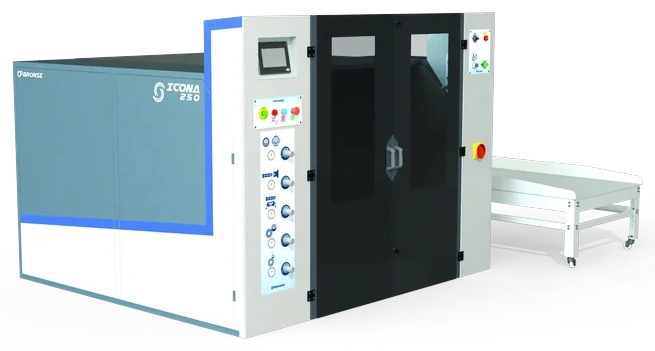
ICONA 250 is a high-speed coreless film rewinder for stretch film. Instead of winding onto a cardboard core that stays in the roll, it winds onto a removable mandrel. When the roll reaches its diameter, the machine strips it off automatically, leaving a hollow centre made entirely of film.
ICONA 250 reaches up to 1,200 m/min (800 m/min production speed), takes jumbo rolls 300–500 mm wide and delivers finished rolls up to Ø250 mm with a 50 or 76 mm inner diameter. Two servo motors drive the process.
Key features
- Coreless rolls: no cardboard core in the finished product
- Up to 1,200 m/min, 800 m/min production speed
- Jumbo rolls 300–500 mm wide, up to Ø480 mm and 70 kg
- Finished rolls up to Ø250 mm, 50 or 76 mm inner diameter
- Film from 5 to 50 micron
- Servo system 2 × 4.4 kW
Technical specifications
| Max. rewinding speed | 1,200 m/min |
| Production speed | 800 m/min |
| Max. jumbo roll diameter | 480 mm |
| Max. jumbo roll weight | 70 kg |
| Jumbo roll width | 300–500 mm |
| Jumbo roll core | 76 mm |
| Max. finished roll diameter | 250 mm |
| Finished roll inner diameter | 50 / 76 mm |
| Film thickness | 5–50 micron |
| Installed power | 14.5 kW |
| Nominal power consumption | 14.5 kWh |
| Servo system | 2 × 4.4 kW |
| Electric supply | 380 V, 3P + N + G, 50/60 Hz |
| Air supply | 6–8 bar, 280 Nl/min |
| Machine dimensions (W × L × H) | 2900 × 2400 × 1660 mm |
| Net weight | approx. 2,300 kg |
Values from the Bronse catalogue 2026. Ask us for the configuration that matches your film and rolls.
Advantages of coreless rolls
- Cost reduction: no cores to buy, store or manage.
- Sustainability: end users have no cardboard core to discard or recycle.
- Shipping efficiency: without the weight and volume of cores, more film fits into each shipment.
- Compact storage: coreless rolls can be wound tightly.
How ICONA 250 works
- A jumbo roll 300–500 mm wide and up to Ø480 mm is mounted on its 76 mm core.
- The film is wound onto a removable mandrel instead of a cardboard core.
- Two 4.4 kW servo motors drive the winding at up to 1,200 m/min (800 m/min production speed).
- At the set diameter or length the film is cut.
- The machine strips the finished roll off the mandrel automatically, leaving a 50 or 76 mm hole made entirely of film.
Who buys coreless rolls
Coreless rolls appeal to users who pay for disposal of packaging waste or report on it, and to distributors who want a product that stands out. End users wrap with a reusable handle or dispenser that fits the hole, so nothing but film is used up. For the producer, there are no cores to buy, store or feed into the machine.
Roll formats explained
Most stretch film is sold in three formats, and a rewinder is what turns the first into the other two:
- Jumbo (mother) rolls come straight off the extrusion line, usually on 76 mm cores. They are too large and heavy to wrap pallets with.
- Hand rolls are short, light rolls for manual wrapping, typically on small cores so they can be held on a handle or dispenser.
- Machine rolls are longer, heavier rolls for pallet wrapping machines. Bronse pallet wrappers, for example, take rolls 500 mm wide, up to Ø250 mm and 16 kg on 76 mm cores.
Roll weight is easy to estimate: weight (kg) ≈ width (m) × length (m) × thickness (micron) × 0.92 ÷ 1,000. A 500 mm × 300 m × 17 micron hand roll weighs about 2.3 kg; a 500 mm × 1,500 m × 23 micron machine roll about 16 kg.
What makes a good finished roll
Buyers judge a rewound roll quickly, so it is worth checking samples against these points:
- Straight edges. The film layers should sit flush; a roll whose layers slide sideways (telescoping) is hard to sell and hard to use.
- Consistent length. Every roll sold as 300 m should hold 300 m. Servo-driven length control is what keeps this repeatable.
- Even winding. No wrinkles, trapped air or loose outer layers, so the roll stays round in transport.
- Film properties kept. Rewinding should not over-stretch standard film or damage cling.
Actual running speed depends on the film. Thin or uneven jumbo rolls normally run below the maximum speed, so send us your film data and we will tell you what to expect.
Preparing your site for the ICONA 250
Everything you need to plan the installation is in the catalogue values:
- Electricity: 380 V, 3P + N + G, 50/60 Hz, 14.5 kW installed power (nominal consumption 14.5 kWh, servo system 2 × 4.4 kW).
- Compressed air: 6–8 bar, 280 Nl/min – the highest air demand of our rewinders, so check your compressor. Clean, dry air keeps pneumatic parts working longer.
- Floor space: 2900 × 2400 mm footprint, 1660 mm high for the machine itself, plus room to bring in jumbo rolls, take finished rolls away and let the operator move around.
- Floor load: net weight approx. 2,300 kg.
- Jumbo handling: jumbo rolls weigh up to 70 kg, so plan how they reach the machine – a hoist, lifting trolley or crane.
Frequently asked questions
How is a coreless roll removed from the machine?
The film is wound on a removable mandrel or air shaft. When the roll is complete, the machine strips it off automatically.
Which inner diameters are possible?
50 or 76 mm.
Do coreless rolls need a special dispenser?
End users wrap with a handle or dispenser that fits the 50 or 76 mm hole. Ask us which inner diameter suits your market.
Which film thickness can ICONA 250 process?
Film from 5 to 50 micron, from jumbo rolls 300–500 mm wide.
Related machines
- ULTIMA 250 – slitter rewinder with cores
- UNIVERSA 250 – pre-stretch rewinder
Get a quote for the ICONA 250
Tell us your jumbo roll width, film thickness and the finished rolls you sell. We will reply with a configuration and a price.


